

Land surface effects on shear balance of squall lines
Submitter
Torn, Margaret S. — Lawrence Berkeley National Laboratory
Williams, Ian N — Iowa State University
Area of research
Surface Properties
Journal Reference
Science
We found that land surface drag (friction) can affect the evolution of simulated squall line thunderstorms. By weakening the near-surface wind and deepening the cold pool (rain-cooled air beneath thunderstorms), surface friction can slow the cold pool's movement and thus help maintain the squall line.
Impact
The classic theory for long-lived squall line thunderstorms (known as RKW theory) does not include land surface effects. By incorporating the land surface, we have shown that the principal idea of RKW theory (involving a balance between the wind shear in the cold-pool and the ambient environment) can still be valid if modified to account for effects of surface friction on wind shear. Our study calls for including this dynamic effect of the land surface in climate models. More broadly, the effects of surface friction on squall lines suggest that land cover change may contribute to changes in rainfall characteristics.
Summary
We explore whether and how the land characteristics, especially surface drag, affect the squall line, in an idealized modeling framework. We find that the balance between the ambient low-level shear and cold-pool-induced shear in the squall line can be modified by surface drag: it not only changes the ambient shear if near-surface environmental wind is nonzero, but also reduces the cold-pool-induced shear by both weakening the low-level wind and deepening the cold pool. The land surface impact on squall lines is larger with lower convective available potential energy (CAPE), partly because of stronger convection with higher CAPE. The cold pool intensity (vertically integrated negative buoyancy) could not explain the reduced cold pool shear induced by the land. Furthermore, land characteristics—such as roughness lengths—help maintain the shear balance and potentially make the squall line long-lived, suggesting that they be included in convective (or cold pool) parameterizations to improve climate and Earth system models.
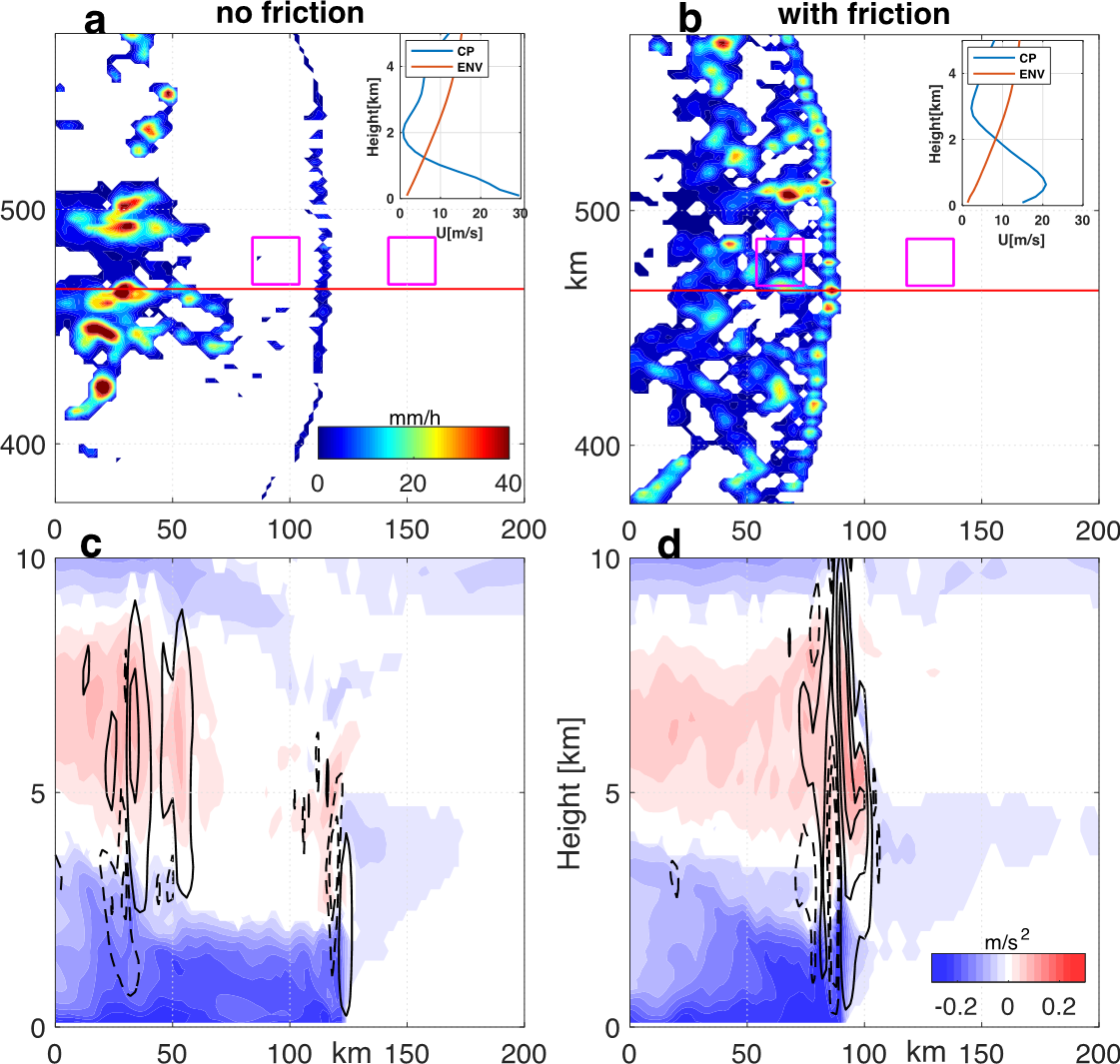
Figure 1. Snapshots of simulated rain rate (shaded) for (a) no surface friction and (b) surface friction experiments. Vertical wind profiles in both the cold pool and environment are also shown. Panels (c) and (d) are the vertical cross section of buoyancy (shaded, m/s2) and vertical velocity (solid lines: 2, 8, 16 m/s; dashed lines: −3, −1 m/s), located at the red line in a, and b, respectively. The updraft vertical velocity is better organized (more vertically coherent) in the friction experiment. From journal.