

Consideration of initial spectral shape in quantifying turbulent entrainment-mixing processes
Submitter
Liu, Yangang — Brookhaven National Laboratory
Area of research
Cloud Processes
Journal Reference
Science
Turbulent entrainment-mixing processes have been proposed to explain outstanding cloud physics problems such as spectral broadening and rain initiation. However, microphysical measures of these processes have been based on a traditional mixing diagram that is only applicable to narrow droplet size distributions. This study investigates the influences of the initial spectral shape of droplet size distributions. Further, existing microphysical measures of homogeneous mixing degree are generalized to consider the influence of spectral shape on the understanding and quantification of entrainment-mixing processes.
Impact
Entrainment-mixing processes remain poorly understood, and the effect of spectral shape of droplet size distribution has been largely ignored in existing measures of entrainment-mixing processes. We examine the influences of initial spectral shape on the traditional mixing diagram and existing measures that work only for narrow droplet size distributions, and we generalize existing measures to consider the spectral shape.
Summary
Turbulent entrainment mixing significantly affects cloud micro/macrophysics and the quantification of aerosol indirect effects. However, it is still an open question as to how to quantify the entrainment-mixing mechanism for broad cloud droplet size distributions (CDSDs). Here, CDSDs with different spectral widths are used to initialize the Explicit Mixing Parcel Model to address this problem, and the resulting microphysical properties are contrasted. For relatively broad CDSDs, the volume-mean radius increases as the number concentration and liquid water content decrease, while the opposite is true for relatively narrow CDSDs. Based on the analysis of the conventional microphysical mixing diagram, the pattern of increasing size with decreasing number concentration (or liquid water content) conforms to what would be generated by inhomogeneous mixing with subsequent ascent, suggesting that isobaric mixing for broad CDSDs could be mistaken as inhomogeneous mixing with subsequent ascent. The corresponding traditional homogenous mixing degrees are unrealistically negative and, therefore, the traditional approach is not applicable to relatively broad CDSDs. This issue is rectified by introducing new measures that explicitly account for the effect of CDSD spectral shapes on quantifying entrainment-mixing mechanisms. The new measures yield reasonable ranges of values that conform to the dynamical measures as expected from physical arguments. This study extends the measures of homogeneous mixing degree from narrow to broad CDSDs, and sheds new light on the consideration of CDSD shapes in the parameterization of entrainment-mixing mechanisms.
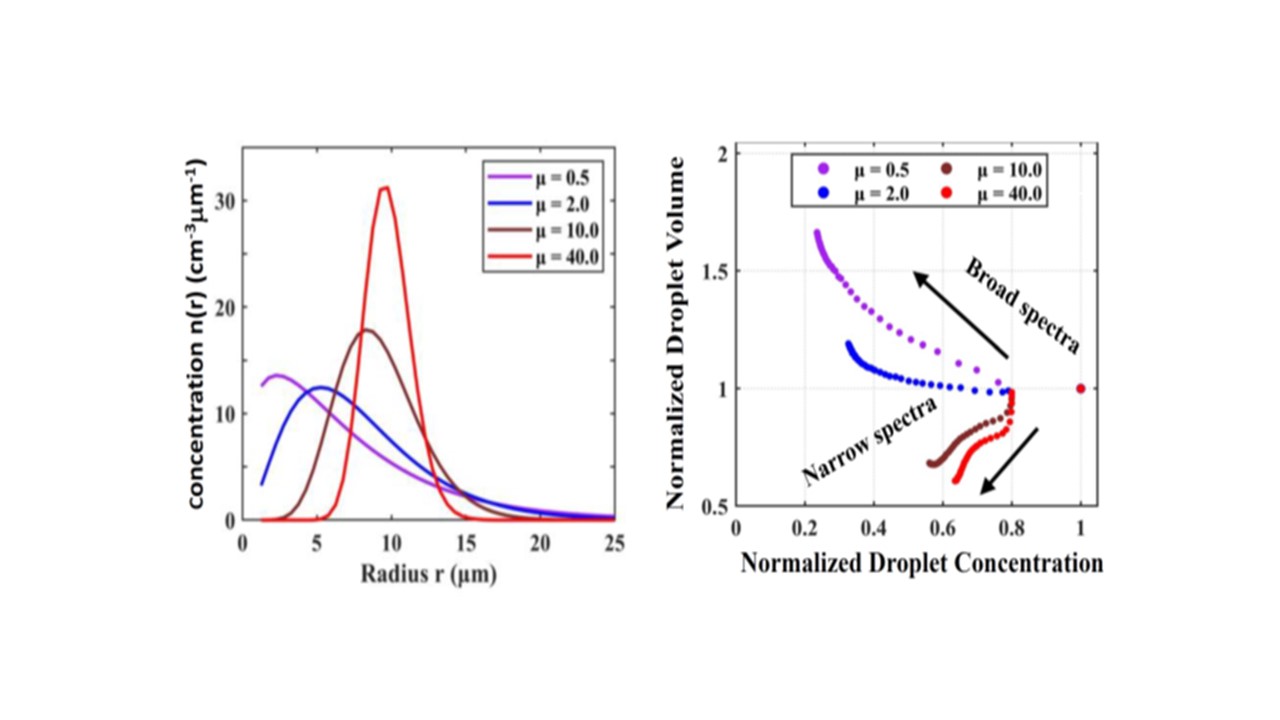
Figure 1. The left plot shows the initial droplet size distributions used in the isobaric mixing simulations with the Explicit Mixing Parcel Model. In the legend, μ is a parameter in the gamma droplet size distribution that indicates spectral width, where the size distributions get broader with smaller μ. The right plot shows the mixing diagrams. The coordinate space is normalized relative to adiabatic values, with normalized cloud droplet number concentration on the x axis and normalized cloud droplet volume on the y axis. Note the transition from positive correlation to negative correlation as μ decreases. Based on the widely used mixing diagram, the latter isobaric mixing could be misinterpreted as inhomogenous mixing with subsequent ascent. From journal.